
Derivation of the Doppler effect formulas
Contents
The Doppler effect
Derivation of the Doppler effect formulas
1. Both source and observer are at rest
2. Source approaching a stationary observer
3. Source moving away from a stationary observer
4. Observer approaching a stationary source
5. Observer moving away from a stationary source
6. Both source and observer moving towards each other
7. Both source and observer moving away from each other
8. Source approaching, observer receding
9. Source receding, observer approaching
10. Summary
Related topic
Tips For Using The Doppler Effect General Formula
The Doppler effect
The Doppler effect is the change in frequency when there is relative motion between a source of waves and an observer.
In the case of sound waves, observed frequency  (i.e., the frequency that is heard by an observer from a distance), is given by

where  is the frequency emitted by the source,
  is the speed of sound (
 in air at 20° C),
  is the speed of the observer, and
  is the speed of the source. Equation (1) was derived on conditions that the source frequency is constant, and both source’s speed and observer’s speed must also be constant. In addition, the motion of source and observer has to be along the line joining them
Derivation of the Doppler effect formulas
Equation Eq. (1) is a combined form of nine separate scenarios: (1) Both source and observer are at rest; (2) Source approaching a stationary observer; (3) Source moving away from a stationary observer; (4) Observer approaching a stationary source; (5) Observer moving away from a stationary source; (6) Source and observer moving towards each other; (7) Source and observer moving away from each other; (8) Source approaching, observer receding; and (9) Source receding, observer approaching. Following sections describe how you can derive each of these equations.
Case 1: Both source and observer are at rest
Sound waves are emitted from the source, with wavelength  , frequency , and travel at speed in the air (the medium) towards the observer. We can use the general formula

to describe the relationship between these quantities.
Thus, for one period  , a sound wavefront travels a distance , which can be expressed as

where 
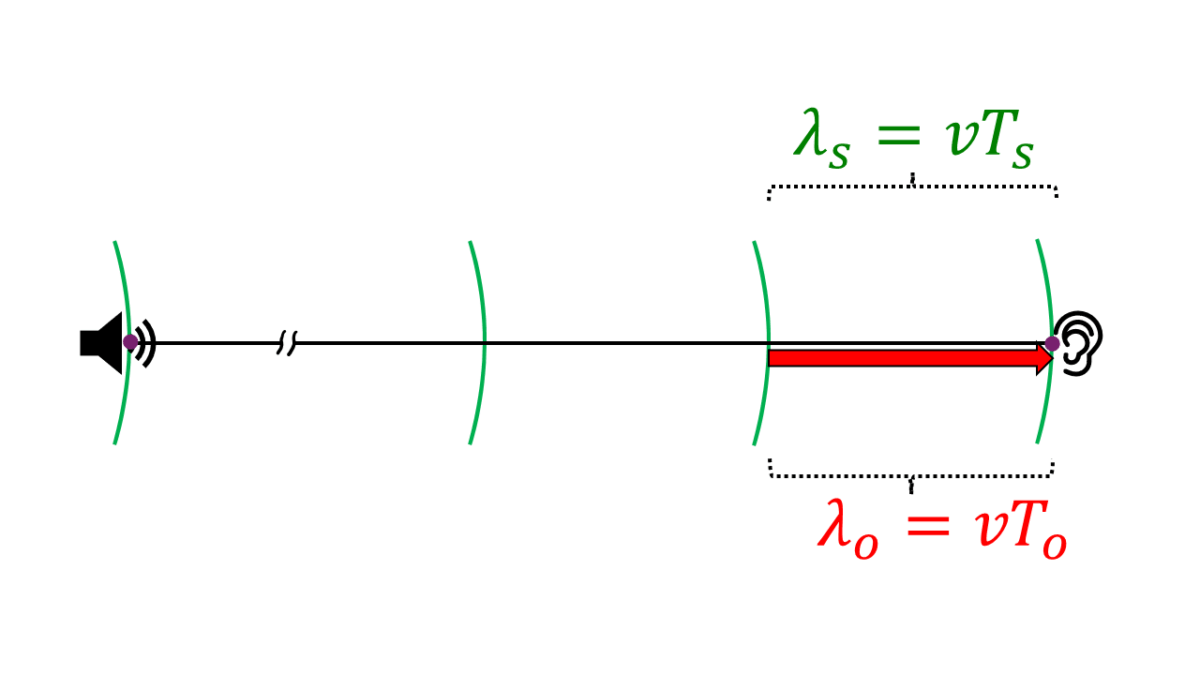
The perceived frequency , as heard by the observer can be obtained from the wave period  — the time between two consecutive wavefronts that reach the observer, since
  .
.
After a wavefront reaches the observer, the next will reach the observer after a time , having travelled a distance 

When both the source and the observer are stationary, there is no relative motion between them,  and
and  ; as a result, no Doppler effect is observed.
Thus,

The observer hears sounds of the same pitch (same frequency) as they are at the source.
Case 2: Source approaching a stationary observer
Assume the first wavefront is emitted at  s. Each consecutive wavefront is emitted every after that, regardless of whether the source is stationary or moving. After emitting a wavefront, if the source is moving toward the stationary observer with speed , then before emitting the next wavefront, it travels a distance
  , where

As shown in the figure below, to reach the observer, the following wavefront (the next wavefront) needs to cover a distance  , which is shorter than

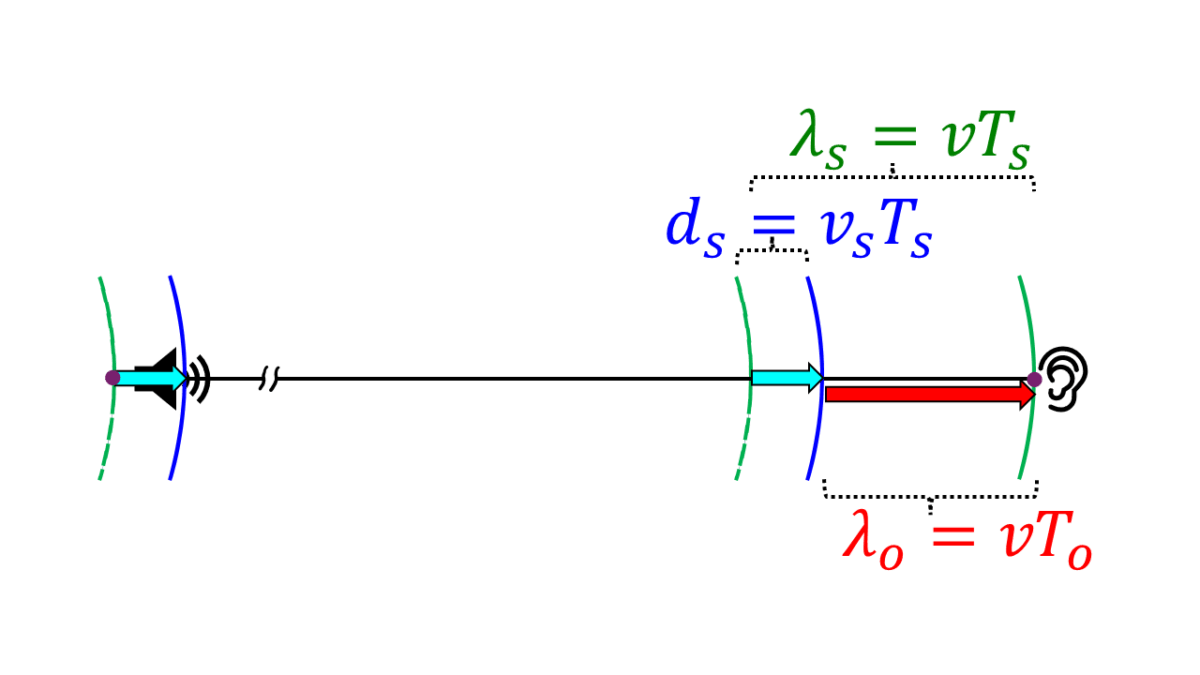
Substituting , , in Eq. (6) with their equivalents from Eqs. (2), (3) and (5), we obtain
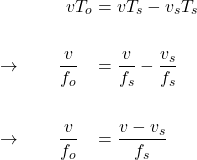
therefore,

As  , is greater than , the observer hears sounds at a higher pitch than they actually are at the source.
Case 3: Source moving away from a stationary observer
Similar to Case 2, but this time, after emitting a wavefront, the source moves a distance away from the observer before releasing the next wavefront. Consequently, the distance that the subsequent wavefront must cover to reach the observer is

as illustrated in the figure below,
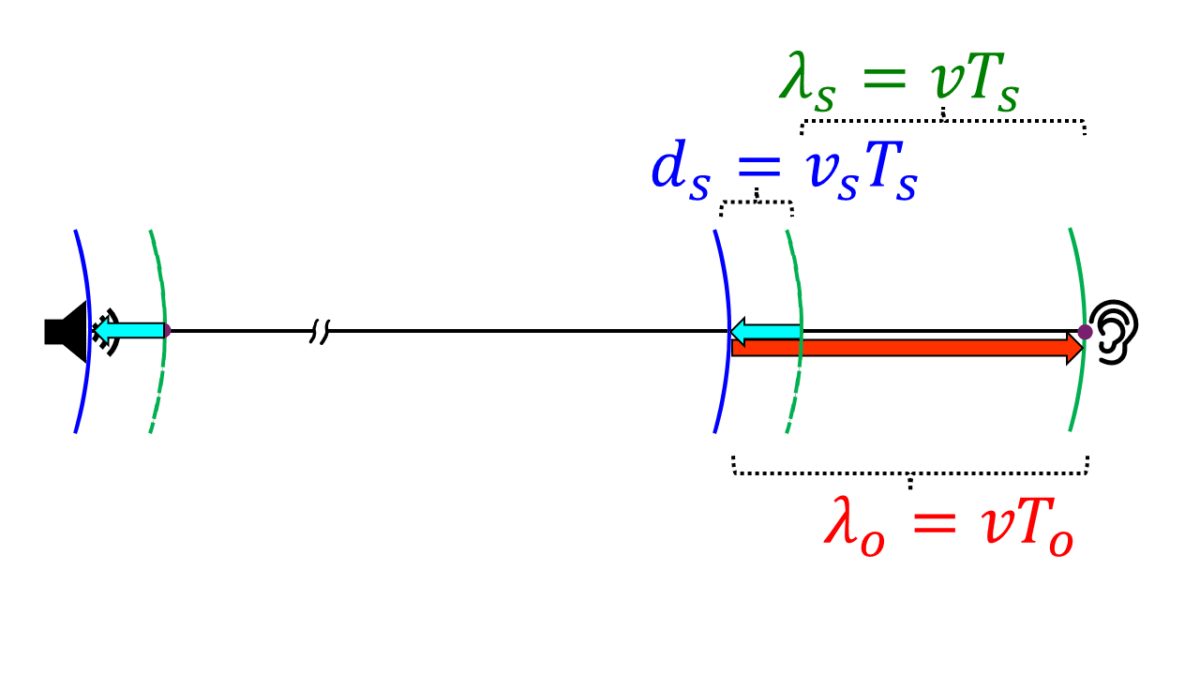
Substituting , , in Eq. (8) with their equivalents from Eqs. (2), (3) and (5), we obtain
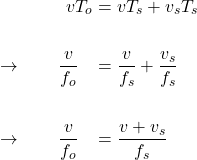
therefore,

As  ,
,  , the observer hears sounds at a lower pitch than they are at the source.
Case 4: Observer approaching a stationary source
In this case, the source is stationary and the observer moves toward it with speed . After encountering one wavefront, the observer meets the next after a time , having travelled a distance  , where

During that same time, the next wavefront must travel a distance to reach the observer. As shown in the figure below,

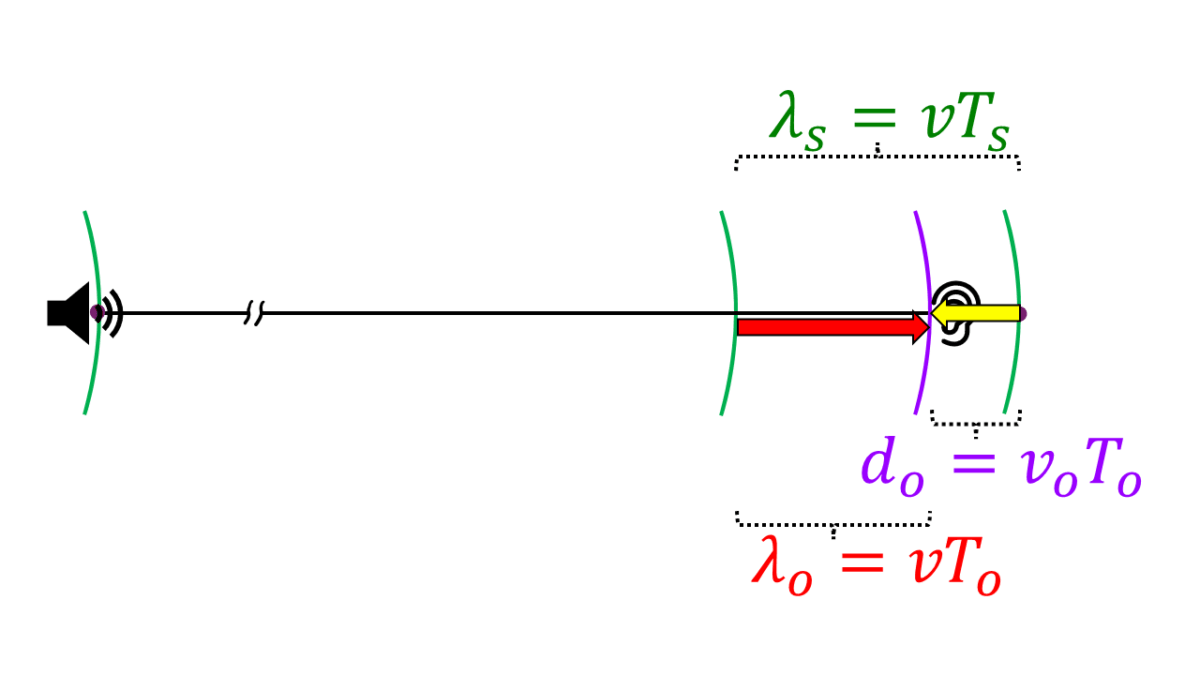
Substituting , , in Eq. (11) with their equivalents from Eqs. (2), (3) and (10), we obtain
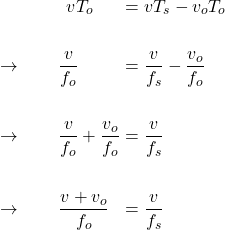
therefore,

Since  ,
,  , the observer hears sounds at a higher pitch than they actually are at the source.
Case 5: Observer moving away from a stationary source
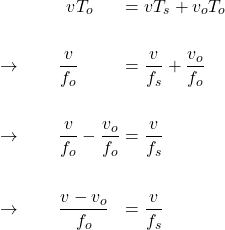
In this case, the source is stationary and the observer moves away from it with speed . As illustrated in the figure below, once a wavefront passes the observer, the next wavefront must travel a distance  over a time interval to reach the observer. Therefore

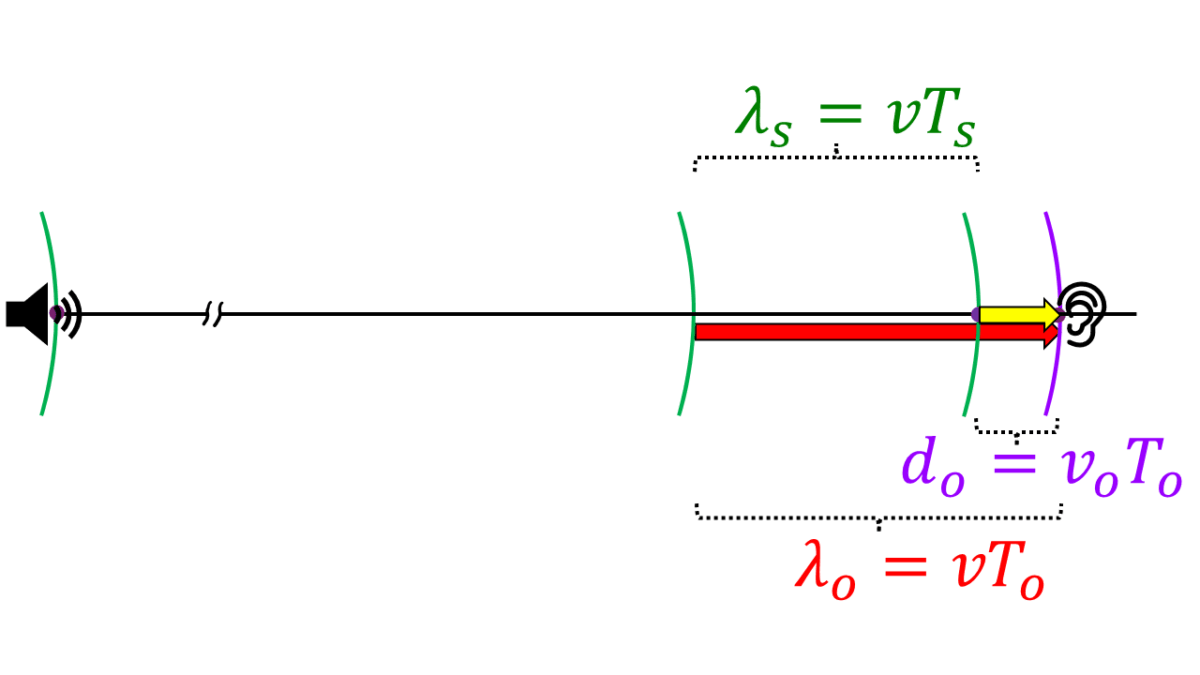
Substituting , , in Eq. (11) with their equivalents from Eqs. (2), (3) and (10), we obtain
therefore,

Since  , , the observer hears sounds at a lower pitch than they are at the source.
Case 6: source and observer moving towards each other
This case combines Cases 2 and 4, in which the source approaches the observer with speed , while the observer simultaneously moves toward the source with speed . As shown in the figure below, the effective spacing between consecutive wavefronts can be expressed as

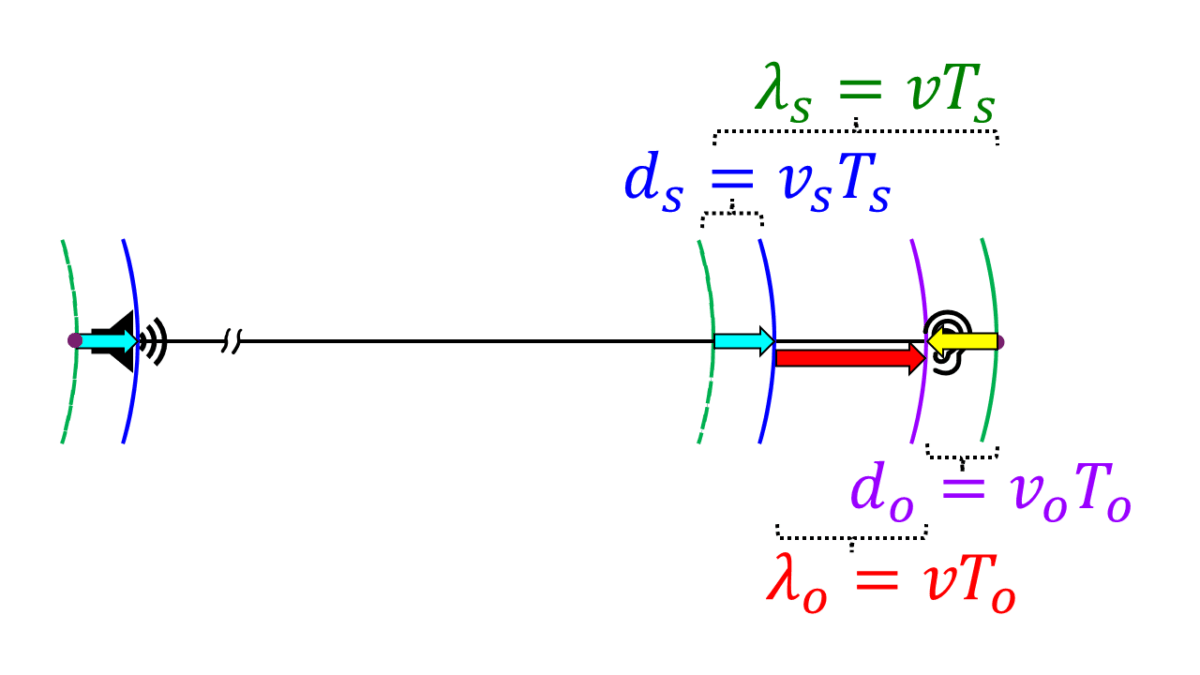
Substituting , , , in Eq. (15) with their equivalents from Eqs. (2), (3), (5) and (10), we obtain
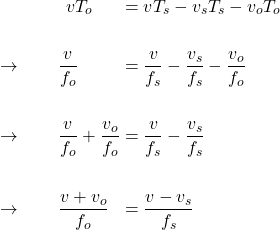
therefore,

Since  , , the observer hears sounds at a much higher pitch than they actually are at the source.
Case 7: source and observer moving away from each other
Since the source recedes from the observer with speed while the observer simultaneously moves away from the source with speed , the distance between consecutive wavefronts is stretched as illustrated below.
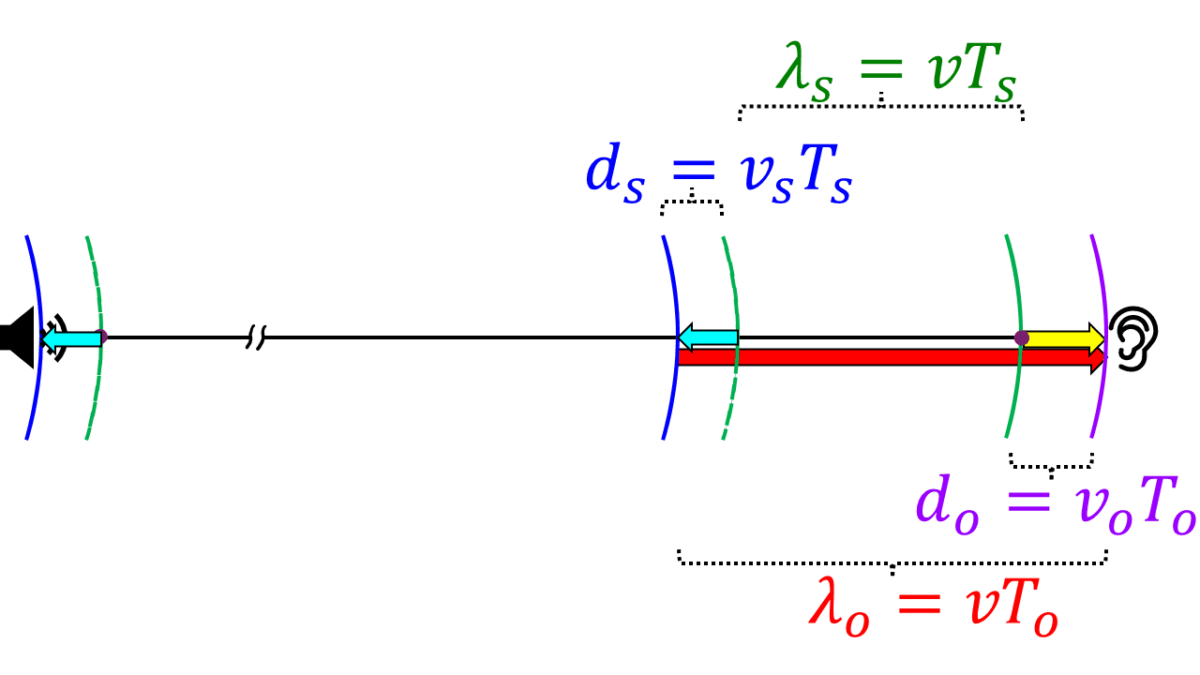
Thus,

Substituting , , , in Eq. (17) with their equivalents from Eqs. (2), (3), (5) and (10), we obtain
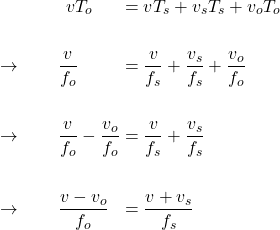
therefore,

Since  , , the observer hears sounds at a much lower pitch than they are at the source.
Case 8: Source approaching, observer receding
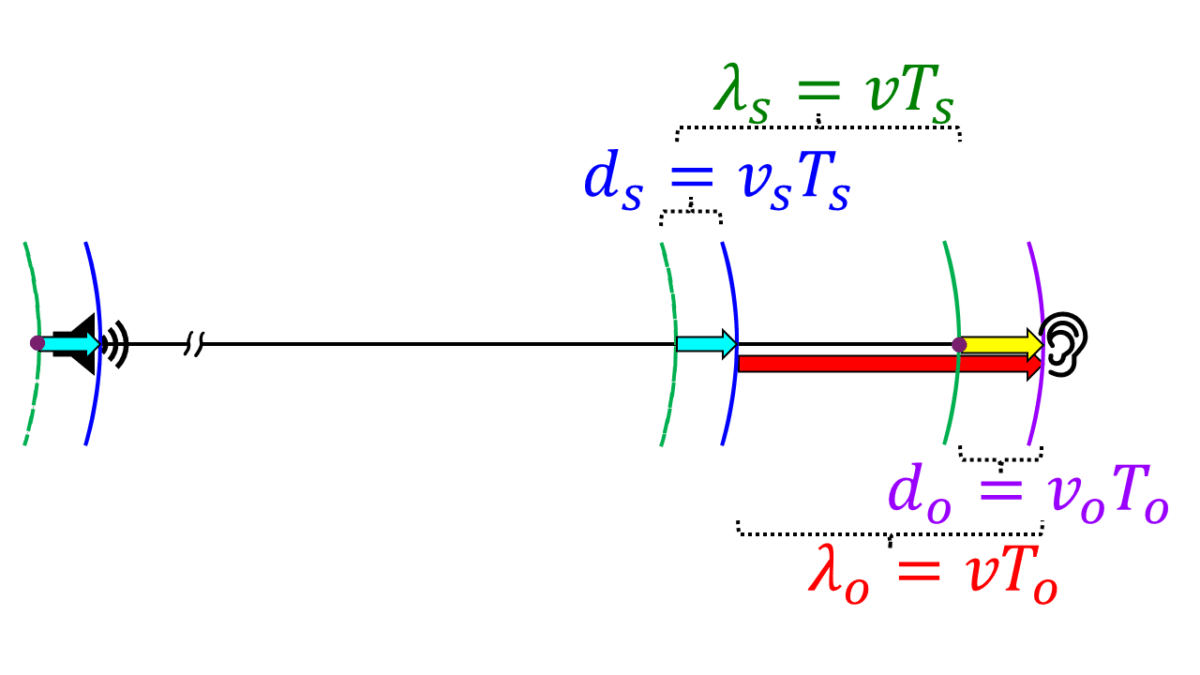
As shown above, when the source approaches the observer with speed while the observer moves away with speed , the distance between consecutive wavefronts can be expressed as

hence
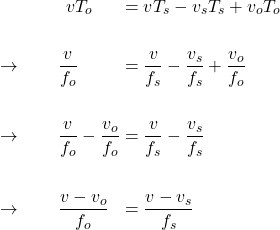
therefore,

In this case, if  , then the net effect is that the source is approaching, therefore, , and the observer hears a higher-pitched sound. The opposite occurs if
  .
.
Case 9: Source receding, observer approaching
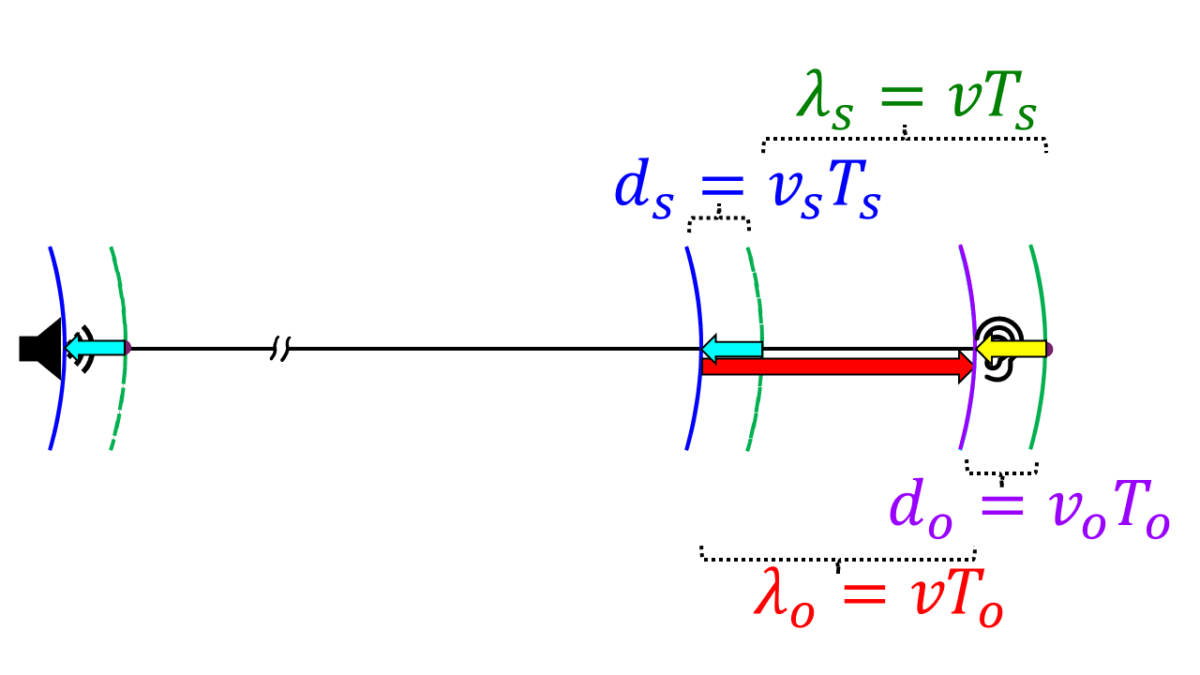
As shown above, when the source moves away from the observer with speed while the observer approaches the source with speed , the distance between consecutive wavefronts can be expressed as

hence
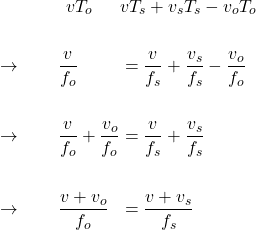
therefore,

In this case, if  , then the net effect is that the source is receding, therefore, , the observer hears a lower-pitched sound. The opposite occurs if
  .
.
Summary
By combining all nine equations, 4, 7, 9, 12, 14, 16, 18, 20, and 22, we obtain
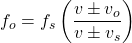
This is the same general equation (Eq. 1) mentioned earlier in the introduction to the Doppler effect, which combines all relative motions between a sound source and an observer along the straight line joining them.
Identifying the appropriate Doppler-effect equation for a specific scenario using the general Doppler effect formula can be confusing. A simple way to make the task easier is to note that the ratio on the right hand side of the general formula represents the relative speed of the sound wave and the observer, (||–||), over the relative speed of the sound wave and the source, (||–||).
If we choose the propagation direction of the sound wave toward the observer as the positive direction, then the value of is always positive, so ||  .
.
If the source moves in the same direction as (the positive direction), then ||  , therefore
||–||  (source approaching)
If the source moves in the opposite direction, then ||  , and therefore
||–||  ||–(
||–( )
)  (source receding)
Similarly, for the observer’s motion: if the observer moves in the same direction as , then ||  , and therefore
||–||  (observer receding)
If the observer moves in the opposite direction, then ||  , and therefore
||–|| ||–( )
)  (observer approaching)
A more detailed explanation on how to extract the correct Doppler-effect equation for a given relative motion between the source and the observer from the general formula can be found here.